01 / Vegetable production
Crop rows with seasonal access
Record field dimensions, row centers, lateral length and headland access. Discuss whether tubing is replaced seasonally or retained, how it is recovered and which joints must survive routine field work.
Ask the factory to show how the specified zone demand relates to available supply flow. A control schedule cannot correct an undersized water inlet or unexplained pressure loss.
02 / Greenhouse operation
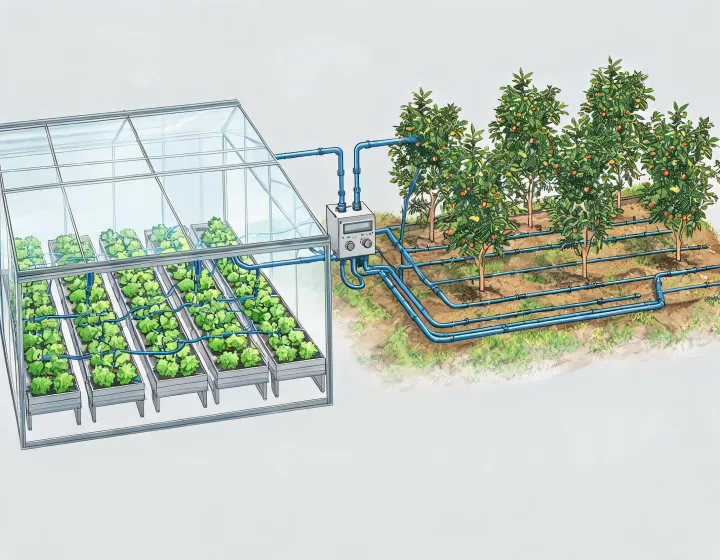
Benches and crop-specific zones
List bench arrangement, crop groups, irrigation points and fertigation requirements. Confirm whether dosing equipment, backflow protection and control integration belong to the supplied scope or remain the operator's responsibility.
Water chemistry and cleaning practices affect compatibility. Request material information and maintenance instructions for every component exposed to the proposed fertilizer solution.
03 / Orchard installation
Long runs and elevation changes
Supply elevation information and the intended lateral routing. Ask whether a pressure-compensating drip irrigation emitter is appropriate within its documented pressure range; the label alone is not proof of uniform delivery.
Keep filtration access and flushing points in the layout. Long lines need a practical maintenance plan, not simply a controller added to the purchase list.
04 / Nursery distribution
Containers with changing demand
State container arrangement, emitter count, movement of stock and the replacement connectors needed. Frequent layout changes can make service access and spare fittings more relevant than a low initial component price.
Agree which functions remain usable without network access and how local staff can identify a failed sensor or valve before relying on remote monitoring.